Dealerships across the U.S. spend heavily on advertising every month, and a meaningful share of that spend still leaks out through the same avoidable mistakes. Cox Automotive tracks U.S. dealership marketing spend in the billions of dollars annually, yet study after study shows that a large portion of that budget either fails to reach genuinely in-market shoppers or fails to convert once it does reach them. The problem is rarely the size of the budget. It's how that budget gets planned, targeted, and followed up on.
For dealership owners and marketing managers, the goal isn't to spend more. It's to stop losing ground to mistakes that are well documented, easy to spot once you know what to look for, and, in most cases, straightforward to fix. These mistakes tend to cluster into three categories: how the ad is built, where the budget gets allocated, and what happens after a shopper actually responds. All three matter, and a strong result in one area rarely compensates for a weak result in another.
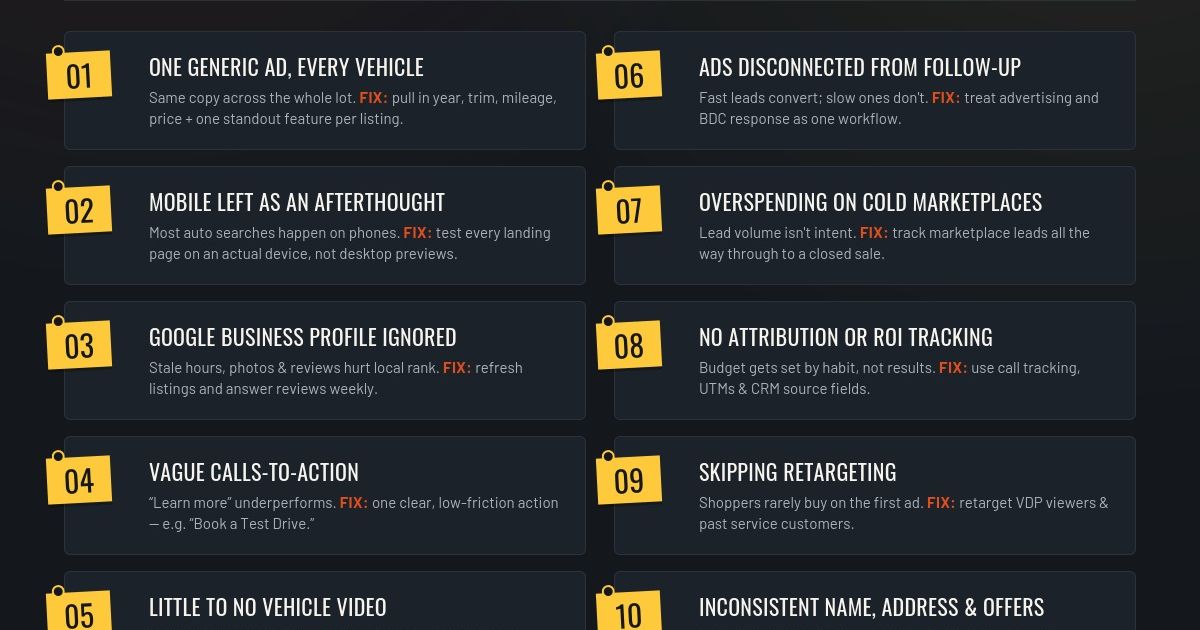
Below are the ten mistakes that show up most often in dealership advertising audits, the U.S. industry research behind each one, and what to do instead.
1. Treating Every Vehicle Ad Like a Generic Ad
Many dealerships still run the same ad copy and creative across an entire inventory segment, whether that means every SUV on the lot or every certified pre-owned sedan. Shoppers notice the sameness, and it costs clicks. Cox Automotive's Car Buyer Journey research has repeatedly found that today's buyers do extensive vehicle-specific research online long before they ever set foot on a lot, comparing trim levels, features, mileage, and pricing across multiple listings and multiple dealerships at once.
When every ad looks and reads the same, a dealership is competing on price alone instead of on the specific reasons a particular vehicle is worth a look. That's a losing position against dealers who tailor their messaging vehicle by vehicle.
Source: Cox Automotive, Car Buyer Journey Studies
Fix: Build ad templates that automatically pull in vehicle-specific data — year, trim, mileage, price — and one or two standout features — rather than running one static ad across dozens of listings.
2. Underinvesting in Mobile Optimization
Google's own research into auto shopping behavior has found that a majority of automotive searches now happen on mobile devices, and mobile is where most shoppers first discover a dealership's ads, vehicle detail pages, and specials. A landing page that loads slowly, or renders awkwardly on a phone screen, loses the shopper before the sales pitch even has a chance to start.
This mistake is especially costly because it's invisible from a desktop review. A campaign can look polished in a conference room and still perform poorly in the real world, where most shoppers are tapping through it on a phone while doing something else.
Source: Think with Google, Automotive Marketing Insights
Fix: Audit every ad's landing destination on an actual phone, not just a desktop preview. Page speed, tap-friendly CTA buttons, and one-tap click-to-call functionality matter more on mobile than almost anything else in the funnel.
3. Neglecting Google Business Profile and Local SEO
Paid ads get most of the attention and most of the budget, but a large share of dealership discovery still happens through local, organic search — searches like "used SUVs near me" or "Toyota dealer [city]." Google's own local search guidance shows that profile completeness, including hours, photos, Q&A activity, and review responses, has a measurable effect on whether a dealership even appears in the local map pack, regardless of how much is spent on search ads running in parallel.
Dealers who treat their Google Business Profile as a set-it-and-forget-it listing are often outranked locally by smaller competitors who simply keep their profile current and actively respond to reviews.
Source: Google, Google Business Profile Help & Best Practices
Fix: Treat Google Business Profile as a paid-adjacent channel, not an afterthought. Keep inventory highlights, hours, and photos current, and respond to reviews on a weekly cadence rather than a quarterly one.
4. Weak or Missing Calls-to-Action
"Learn more" and "Visit our website" remain two of the most overused calls-to-action in dealership advertising, and they're also among the least effective. Dealer marketing research from DAS Technology has found that ads and landing pages built around a single, specific, low-friction action — schedule a test drive, get my trade-in value, book a service appointment — consistently outperform generic phrasing on both click-through rate and lead conversion.
Vague CTAs put the burden of figuring out the next step on the shopper. Specific CTAs remove that friction entirely and tell the shopper exactly what happens if they click.
Source: DAS Technology, Dealer Marketing Research
Fix: Pick one action per ad. "Book a Demo," "Get My Trade-In Value," and "Schedule a Test Drive" all outperform vague, low-commitment phrasing because they set a clear, low-effort expectation.
Checked most of these boxes already?
Good. Now make sure every lead gets worked.
5. Ignoring Video and VDP-Specific Content
Vehicle walk-around videos and short-form video ads consistently rank among the highest-engagement ad formats in the automotive space, according to J.D. Power's automotive shopper studies, yet most dealer marketing budgets still lean almost entirely on static photo ads. Buyers who watch a vehicle-specific video before reaching out tend to arrive further along in the buying process, which shortens the overall sales cycle and reduces the number of back-and-forth questions a salesperson has to field.
Video is also one of the few formats that can showcase condition, sound, and feel in a way photos simply can't, which matters more for used and certified pre-owned inventory than for new.
Source: J.D. Power, Automotive Shopper Studies
Fix: Add a short walk-around video to vehicle detail pages for top-turning inventory, and repurpose those same clips as vertical video ads on social platforms rather than producing separate creative from scratch.
6. Disconnecting Advertising from BDC Follow-Up
This is one of the most expensive mistakes in the industry, and one of the easiest to miss because it happens after the ad has already done its job. An ad generates a lead, and that lead sits in a queue for hours before a human responds. NADA and multiple BDC-focused industry studies have tied response speed directly to close rate — leads contacted within the first few minutes convert at meaningfully higher rates than leads contacted the next business day.
For a full breakdown of why this gap exists and what fixes it, see why follow-up is the make-or-break factor in dealership marketing.
No amount of advertising creativity fixes a slow follow-up process. The ad's only job is to generate the lead; what happens in the next five to ten minutes decides whether that lead turns into a sale.
Source: NADA, NADA Data & Dealer Research
Fix: Advertising and BDC follow-up need to be managed as one connected workflow, not two separate departments. If a campaign can generate the lead but the dealership can't respond quickly, the ad spend is effectively being wasted downstream, after the click has already been paid for.
7. Overspending on Low-Intent Marketplace Listings
Third-party marketplaces, including Facebook Marketplace and other listing aggregators, can generate real volume, but volume isn't the same thing as intent. Dealers who pour a disproportionate share of budget into broad marketplace visibility, without segmenting for high-intent, ready-to-buy behavior, often end up with inflated lead counts paired with weak show rates and even weaker close rates.
This mistake is easy to miss because the top-line lead numbers look strong. It only becomes visible once those leads are tracked all the way through to an actual sale.
Source: Cox Automotive, Market Insights & Industry Reports
Fix: Track marketplace leads all the way through to sale, not just to lead-form submission, before deciding where to shift budget. A channel with fewer, higher-intent leads can outperform a channel with high volume and low follow-through.
Is your BDC keeping up with your ad spend? Super Producer connects the two automatically.
8. Failing to Track Attribution and ROI
It's common for a dealership to run search, social, marketplace, and OEM co-op advertising simultaneously with no shared attribution model connecting any of it. Without one, there's no reliable way to know which channel actually drove a given sale, so budget tends to get reallocated by habit or gut feeling rather than by performance.
This gap tends to widen over time. Each year's budget gets set based on the previous year's spend rather than the previous year's results, which quietly locks in whatever mistakes were already baked into the plan.
Source: PwC, Digital Auto Report
Fix: Use call tracking, UTM parameters, and CRM source fields consistently across every single campaign, so spend can eventually be tied to actual sales rather than just clicks or raw lead counts.
9. Overlooking First-Party Data and Retargeting
Most vehicle shoppers research for weeks before making a purchase decision, which means the very first ad they see is rarely the one that ultimately converts them. Dealerships that don't retarget website visitors, vehicle detail page viewers, and past service customers are effectively re-buying the same cold attention over and over, instead of building on interest they've already earned once.
Retargeting is also one of the more cost-efficient tactics available, since the audience has already demonstrated interest and typically requires less persuasion than a completely cold audience.
Source: Think with Google, Automotive Consumer Insights
Fix: Build a retargeting sequence specifically for vehicle detail page viewers, and keep a separate, always-on retargeting loop running between the service department and the sales team year-round.
10. Inconsistent NAP and Brand Messaging Across Channels
Name, address, and phone number (NAP) inconsistencies across Google, social platforms, and third-party listing sites quietly hurt both local search rankings and buyer trust. The same is true of inconsistent offers or pricing shown across channels, which creates confusion and erodes credibility before a shopper ever picks up the phone.
This mistake tends to accumulate gradually, as new listings get created over the years without anyone auditing the older ones for accuracy, until a dealership has several slightly different versions of its own name and address circulating online at once.
Source: Google, Google Business Profile Help & Best Practices
Fix: Audit NAP data and current offers on a quarterly basis across every platform where the dealership has a listing, not just the primary website and Google Business Profile.
The Common Thread
None of these ten mistakes come down to a lack of creative talent or an insufficient ad budget. They come down to alignment: matching the message to the specific vehicle, matching the channel to the shopper's actual stage in the buying journey, and matching the ad spend to a follow-up process that can genuinely convert the lead it just generated.
Dealerships that fix the connective tissue between advertising and follow-up consistently see stronger results than dealerships that simply increase spend without addressing these underlying gaps. In most cases, the fix costs far less than the mistake it corrects.
A Quick-Reference Checklist for Your Next Campaign
Before launching or renewing any advertising campaign, it helps to run through a short checklist rather than relying on memory. The following questions map directly back to the ten mistakes above and can be reviewed in a few minutes for any campaign, new or existing.
- Does this ad reference the specific vehicle — year, trim, mileage, price — or could it apply to any vehicle on the lot?
- Has the landing page been checked on an actual phone this month, not just on desktop?
- Is the Google Business Profile current, with recent photos and review responses from the past week?
- Does the ad point to one specific, low-friction action, rather than a generic "learn more"?
- Is there a short video attached to this vehicle or offer, not just static photos?
- What is the average time between lead submission and first contact for leads from this campaign?
- Are marketplace leads being tracked through to sale, or only to lead-form submission?
- Can this campaign's performance be tied to actual sales through call tracking, UTM parameters, or CRM source fields?
- Is there an active retargeting audience built from VDP viewers and past service customers?
- Has the dealership's NAP data and current offers been checked across every listing platform this quarter?
A dealership that can answer "yes" to most of these questions is already ahead of a large share of the competition, since these gaps tend to persist for years once they take hold in a marketing plan.
Why These Mistakes Persist
It's worth asking why mistakes this well documented continue to show up across the industry year after year. Part of the answer is organizational: advertising, website management, and BDC follow-up are frequently handled by different people, different vendors, or different departments that rarely compare notes. A campaign can be flawless on the advertising side and still underperform because the follow-up process on the other end can't keep pace with the leads it generates.
Part of the answer is also inertia. Once a media mix, a set of ad templates, or a CTA style becomes the default, it tends to get renewed each budget cycle automatically rather than re-evaluated against current performance data. Fixing that usually requires someone to deliberately step back and audit the full path from ad impression to closed sale, rather than optimizing any single piece of it in isolation.
Get Faster, Smarter Follow-Up on Every Lead
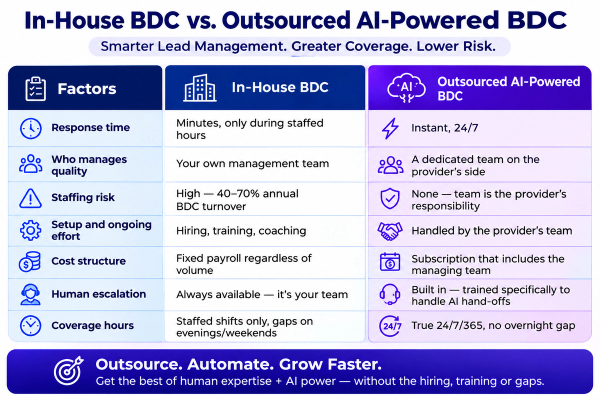
Fixing advertising mistakes only pays off if every lead that results gets a fast, consistent response. A perfectly targeted, vehicle-specific ad with a clear CTA can still lose the sale if the lead it generates sits unanswered for hours. Super Producer's AI-powered BDC platform picks up exactly where the ad campaign leaves off, engaging leads instantly and around the clock so dealerships stop losing sales to slow follow-up, regardless of which channel the lead originally came from.
For dealership owners and marketing managers looking to close the gap between ad spend and closed sales, connecting advertising performance to a faster, more consistent follow-up process is one of the highest-leverage changes available.
Book a Demo at superproducer.ai

Manan Bhalodia
Expert in automotive AI solutions and customer service optimization. Passionate about helping automotive dealerships leverage technology for growth.