On this page
If you run a dealership, you already know the uncomfortable truth about your Business Development Center: it's either your biggest revenue lever or your biggest source of leaking leads. There isn't much middle ground.
A Harvard Business Review study on B2C and B2B online leads found that companies that attempted to contact a lead within one hour were nearly seven times more likely to qualify that lead than companies that waited even 60 minutes.¹ In a car business where the average shopper contacts multiple dealers before ever setting foot on a lot, that one-hour window (often much shorter) is the difference between a sale and a lost opportunity.
Most dealerships know their BDC has room to improve. What's harder to figure out is whether the fix is hiring more staff, buying new software, or bringing in outsourced BDC automotive support to handle it full time. This guide walks through exactly how to evaluate automotive BDC services, what separates a strong dealership BDC partner from a weak one, and where AI-powered platforms like Superproducer fit into the decision.
What Is a BDC in a Car Dealership?
A Business Development Center (BDC) is the team responsible for handling incoming leads, phone calls, and internet inquiries, then converting them into booked appointments for your sales floor. It's the connective tissue between marketing spend and showroom traffic.
BDC outsourcing means handing some or all of that function — lead response, appointment setting, follow-up sequences, even service reminders — to a third-party team or platform that specializes in automotive BDC services, instead of building and managing that capability entirely in-house.
There are generally three models dealerships choose between:
- Fully in-house BDC — your own hired, trained, and managed team
- Outsourced human BDC — a vendor's staff handles calls/leads on your behalf, usually from an off-site call center
- AI-powered BDC — software (sometimes paired with human oversight) handles lead response, qualification, and appointment setting using automation and conversational AI
For a deeper look at what each of these roles actually involves day to day, see What is Automotive BDC and Its Best Practices?.
Each has trade-offs, and the 'right' answer depends on lead volume, budget, and how much control you want to retain."
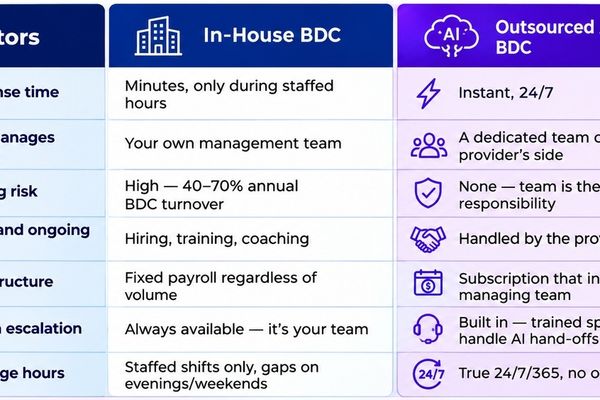
"For the full cost and coverage comparison between these models, see In-House vs. Outsourced BDC: Which Is Right for Your Dealership?
Why This Decision Matters More Than It Used To
The stakes around lead response have gone up, not down. A few numbers worth sitting with:
- Businesses that respond to a lead within 5 minutes are reportedly up to 21 times more likely to convert that lead into a qualified opportunity compared to waiting 30 minutes, according to lead response research popularized by InsideSales.com
- Cox Automotive's Car Buyer Journey research has repeatedly shown that today's car buyers do the majority of their research online before ever contacting a dealer, and they typically contact more than one dealership during the process.
- CallSource, which tracks dealership phone call data, has reported that a meaningful share of inbound sales calls at dealerships go unanswered or mishandled, representing direct, avoidable revenue loss.⁴
- NADA (National Automobile Dealers Association) data shows the average new-car dealership's gross profit per unit has become increasingly dependent on service and F&I, making it even more important to protect every sales opportunity from the BDC.
These numbers only matter if you know which levers actually move them — for a deeper look at speed to lead, follow-up cadence, and CRM hygiene as conversion drivers, see How BDC Teams Improve Lead-to-Sale Conversion Rates.
Every hour your BDC takes to respond is a lead talking to a competitor. See how Superproducer responds in seconds, not hours - Book a Demo
Signs Your Dealership Needs a BDC Outsourcing Partner
You probably don't need to overhaul your BDC if it's hitting its numbers. But a few warning signs tend to show up consistently in dealerships that are leaving money on the table:
- Leads sit unanswered for hours, especially evenings, weekends, and holidays
- Your BDC reps are also pulled onto the sales floor, splitting their focus
- Appointment show rates are declining even though lead volume is steady or growing
- You can't get clean reporting on response time, contact rate, or appointment-to-sale conversion
- Turnover on your BDC team means constant retraining and inconsistent scripts
- Your CRM is full of leads with no follow-up history
If two or more of these sound familiar, it's worth seriously evaluating outsourcing — either to a human BDC vendor or an AI-powered platform.
The Core Criteria for Choosing a BDC Outsourcing Partner
This is the part that actually matters. Here's what to evaluate, roughly in order of impact.
1. Speed to Lead
This is the single most important metric in BDC performance. Ask any potential partner directly:
- What is your average first-response time, in minutes, across all lead sources?
- What happens to a lead that comes in at 9 pm on a Sunday?
- Is response time guaranteed contractually, or just aspirational?
A partner who can't give you a specific, measurable number here isn't ready to manage your leads.
2. Technology and CRM Integration
Your BDC partner's tools need to talk to your CRM, your DMS, and ideally your inventory feed — not exist as a separate system you have to manually reconcile every week.
Ask about:
- Native integrations with your specific CRM (VinSolutions, DealerSocket, Elead, etc.)
- Whether lead and call data flows back into your CRM automatically or requires manual entry
- Whether the platform uses AI/automation, human agents, or both — and how the two hand off to each other
3. Automotive-Specific Expertise
Generic call-center BDC outsourcing (used across insurance, real estate, retail, etc.) rarely performs as well as automotive BDC companies built specifically around automotive sales cycles, inventory-based conversations, and trade-in/finance questions.
Ask for:
- Case studies specifically from dealerships, ideally in your segment (new, used, luxury, high-volume)
- Sample call recordings or chat transcripts
- How they train reps or tune AI models on automotive-specific objections (financing, trade value, "just looking" responses)
4. Transparent, Real-Time Reporting
You should never have to ask "how did we do this month" and wait a week for an answer. Look for partners offering:
- Real-time dashboards, not monthly PDF reports
- Metrics broken down by lead source, not just totals
- Appointment set rate and appointment show rate — not just the first one
- Call recordings and lead-by-lead audit trails
5. Compliance (TCPA, DNC, and State Regulations)
This is non-negotiable and often overlooked. Automotive lead outreach is subject to the Telephone Consumer Protection Act (TCPA), Do Not Call (DNC) registry rules, and state-specific regulations that carry real financial penalties for violations.
Ask your partner directly:
- How do you scrub leads against DNC lists before outreach?
- How do you obtain and document consent for texting/calling?
- Who is liable if a compliance violation occurs — you or them?
Get this in writing. A partner who's vague here is a legal liability, not a growth partner.
6. Pricing Model and Contract Flexibility
BDC outsourcing pricing generally falls into a few structures:
- Per-lead or per-appointment pricing — you pay based on outcomes
- Flat monthly fee — predictable cost regardless of volume
- Per-seat/per-agent pricing — typical of traditional human BDC vendors
- Software subscription (for AI platforms) — usually tiered by lead volume or dealership size
None of these is inherently better — it depends on your lead volume and risk tolerance. What matters more is contract flexibility: can you scale up during a sales event, scale down in a slow month, or exit the contract without being locked in for 12+ months if performance doesn't hold up?
For a deeper look at hidden fees and contract terms to watch for, see our full cost breakdown of outsourced ai BDC vs. in-house BDC .
7. Scalability
A good BDC partner should be able to handle a slow Tuesday and a Memorial Day sales event without a drop in response quality. Ask how they handle sudden spikes — whether that's overflow staffing (human vendors) or infrastructure capacity (AI platforms).
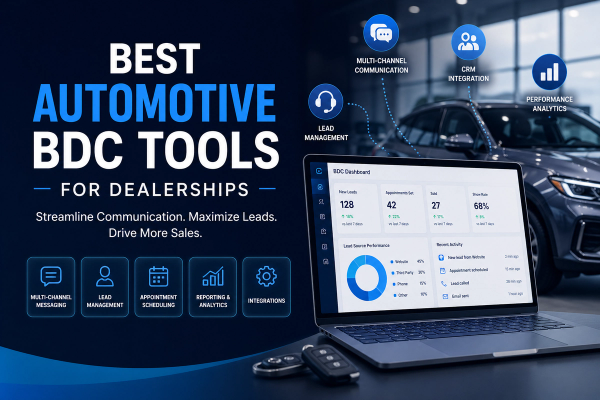
For a breakdown of what a modern BDC tech stack should include, see [Best Automotive BDC Software for Dealerships].
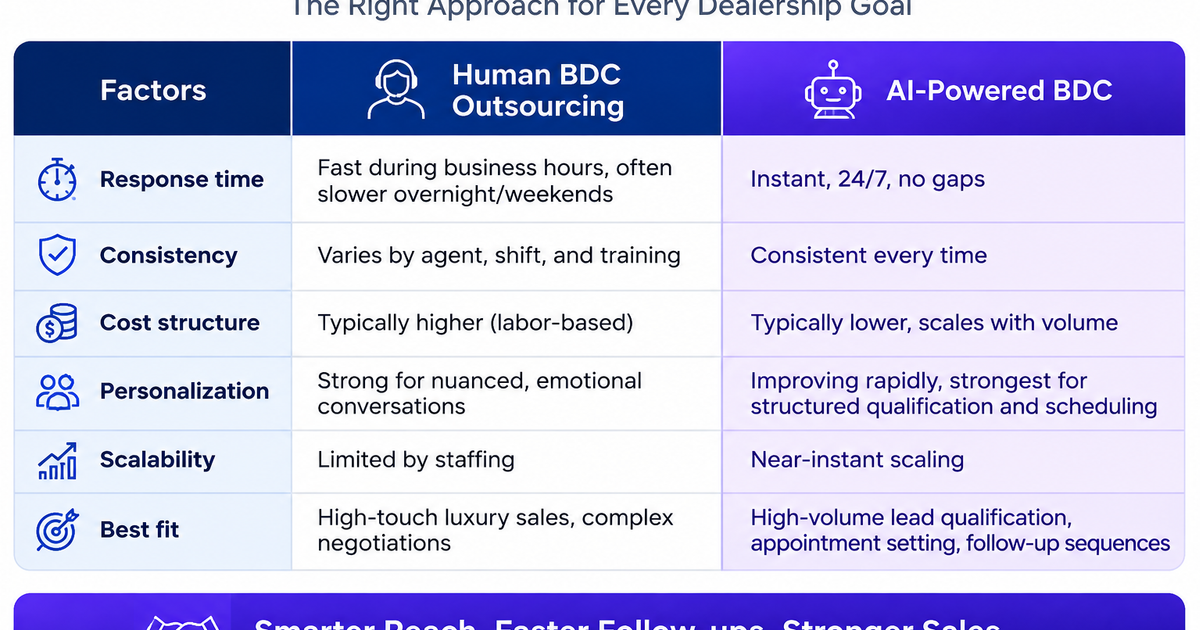
Human BDC Outsourcing vs. AI-Powered BDC: What's the Real Difference?
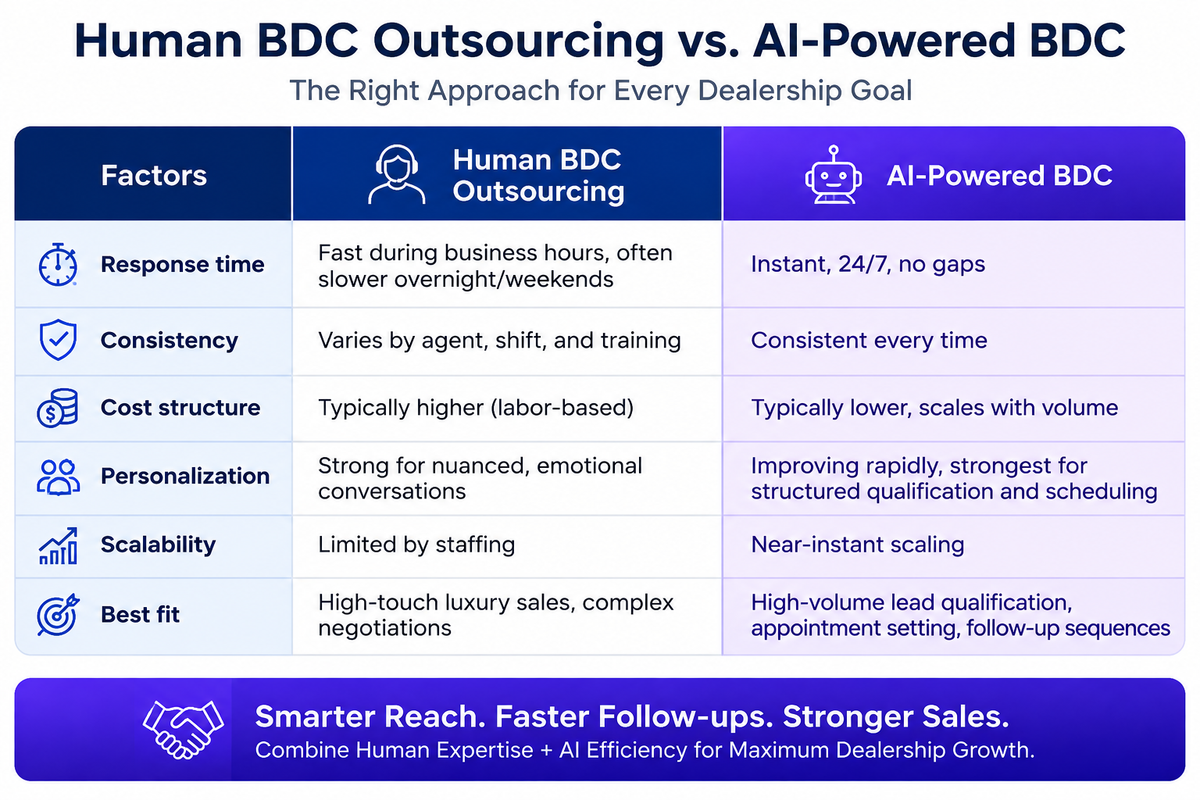
In practice, the strongest setups today are hybrid: AI handles instant first response, qualification, and scheduling around the clock, while human BDC reps or your sales team step in for high-value or emotionally complex conversations. This is the model most dealerships are moving toward, and it's the gap platforms like Superproducer are built to close — AI that responds in seconds, qualifies the lead against your actual inventory, and books the appointment directly into your calendar, with human escalation built in when a conversation needs it.
For more on how this hybrid model — AI first response with a dedicated human team behind it — actually works day to day, see Outsourced AI-Powered BDC: What It Is and Why Dealerships Are Switching.
This is exactly how Superproducer runs on — AI for instant response, human handoff when it counts - See How It Works
Red Flags to Watch For
A few warning signs that should make you slow down before signing a contract:
- No specific response-time metric — "we respond quickly" isn't an answer
- No automotive-specific case studies — a generalist vendor with no dealership track record
- Vague compliance answers — especially around TCPA/DNC
- Long lock-in contracts with no performance guarantees
- No visibility into actual conversations — you should be able to review calls, texts, or chat transcripts, not just summary stats
- Pricing that doesn't scale down — if volume drops, your cost should too
Questions to Ask Before You Sign
Bring this list to every discovery call:
- What's your average first-response time across all lead sources, including nights and weekends?
- How do you integrate with our specific CRM and DMS?
- Can we see real call/chat transcripts from current dealership clients?
- How do you handle TCPA and DNC compliance, and who's liable for violations?
- What does your reporting dashboard actually look like — can we see a live demo?
- What's the contract length, and what happens if we want to leave early?
- How do you handle lead volume spikes during sales events?
- Do you use AI, human agents, or both — and how do they hand off to each other?
- Can you share appointment show-rate data, not just appointment-set numbers?
- What happens when something breaks at 11pm on a Saturday?
If a partner hesitates on more than one or two of these, that's information too.
Making the Final Decision
The right BDC outsourcing partner isn't the one with the flashiest pitch deck — it's the one that can show you, in hard numbers, how they'll improve your response time, your appointment show rate, and your cost per sold unit. Everything else is secondary.
Before you sign anything:
- Get response-time commitments in writing
- Run a pilot with a limited lead source before going all-in
- Compare cost per appointment and cost per sold unit, not just the monthly invoice
- Make sure you retain visibility into every conversation happening under your dealership's name
BDC performance compounds. A partner who shaves your average response time from hours down to seconds, and holds that consistency every single day of the week, doesn't just improve one metric — it changes how many of your marketing dollars actually turn into sold units.
Not sure which BDC model fits your dealership? Let's walk through your numbers together - Contact Us

Manan Bhalodia
Expert in automotive AI solutions and customer service optimization. Passionate about helping automotive dealerships leverage technology for growth.