On this page
Key Takeaways
A call to the service lane that rings out, goes to voicemail, or gets a busy signal almost never becomes an appointment — the customer hangs up and calls the next dealership instead. AI call answering solves this by picking up every call, every line, at any hour, understanding what the caller actually wants in natural conversation, and booking the appointment directly into the scheduler on that same call. It doesn't route the caller into a phone tree or take a message for someone to return "within 24 hours" — it closes the booking while the customer is still on the line.
This sits one step earlier in the funnel than reminder texts or no-show prevention. Those tools protect an appointment that already exists. This is about the appointment that never got created because nobody answered the phone.
What a missed call actually costs
Every unanswered ring at the service desk is a lost booking opportunity, not a neutral event. Three outcomes follow a missed call, and only one of them is recoverable:
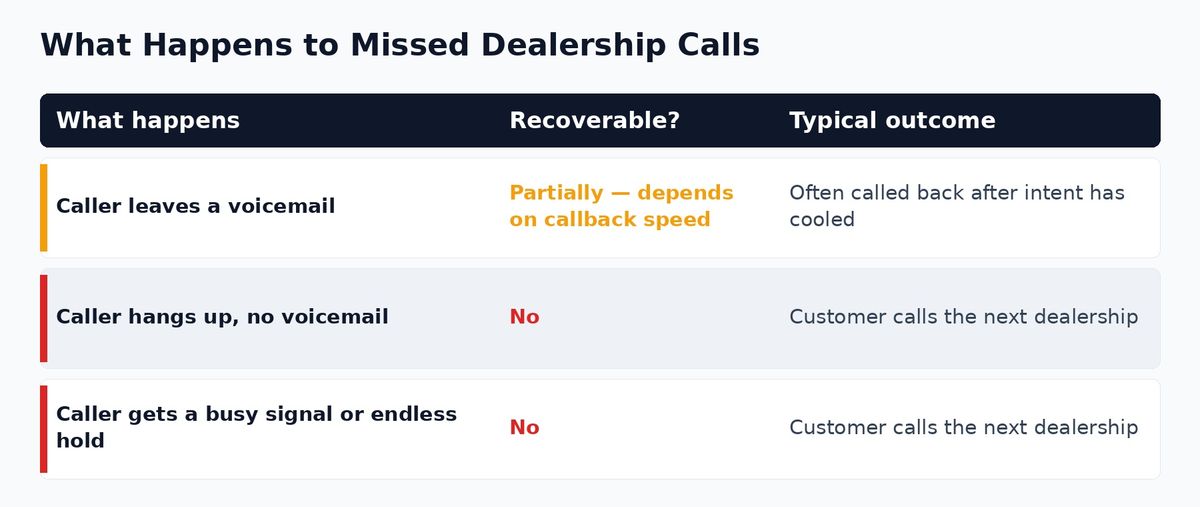
Call abandonment research across service industries consistently shows the majority of callers who reach voicemail or a long hold simply hang up rather than leave a message — they treat the unanswered call as a signal to try somewhere else, not as an invitation to wait. Source: CDK Global Friction Points Study
Service lane phone volume concentrates in narrow windows — opening rush, lunch, and the last hour before close — which is exactly when advisors are busiest on the drive and least able to pick up. Source: Cox Automotive Service Industry Study
The revenue sits in a single number worth pulling from your own phone system: missed-call rate at the service desk. Most dealerships have never measured it, because most phone systems report calls answered, not calls that rang and were never picked up at all.
H2: Why service desk calls go unanswered
This isn't a staffing failure so much as a structural one. Five causes repeat across stores:
1. Advisors are on the drive, not at the desk. The person best positioned to answer a service question is also the person standing with a customer at the counter. Every in-person interaction is a phone call not being answered.
2. Single-line or limited-line phone systems. A busy signal during a call surge sends the customer straight to a competitor with no attempt made at all.
3. Lunch and shift-change gaps. Service departments rarely staff phone coverage during the exact hours callers are most likely to phone in — lunchtime and the first hour after opening.
4. After-hours calls default to voicemail. A large share of service-related calling happens outside the department's open hours, especially from customers calling on a commute or after work to book before the day gets away from them. Source: Cox Automotive Car Buyer Journey Study
5. IVR menus lose callers before they reach a human. A phone tree that asks a caller to press 1 for sales, 2 for service, 3 for parts, then queues them, filters out a meaningful share of callers who hang up during the menu itself rather than wait it out. Source: J.D. Power Customer Service Index (CSI) Study
None of these are solved by asking advisors to answer the phone more. The desk is already busy for a reason — the fix has to sit outside the advisor's time, not inside it.
H2: How AI call answering actually works
"AI answers the phone" undersells what a properly built system does. Four capabilities matter, and a caller should not be able to tell which one they're getting.
Picks up on every ring, every line
No busy signal, no queue, no "all agents are currently assisting other customers." Call volume spikes — Monday mornings, the day after a cold snap, the first sunny weekend of spring — stop being a capacity problem because the system doesn't have a capacity ceiling the way a two-line desk phone does.
Understands natural speech, not menu selections
A caller says "my check engine light came on this morning, can I bring it in today" and the system understands the request rather than routing them through a menu of options that don't match what they're asking. This is the functional difference between AI call answering and IVR: one listens, the other sorts.
Books directly into the live scheduler
The call doesn't end in "someone will call you back." It ends in a confirmed appointment, because the AI has real-time visibility into open service bays and can offer actual times rather than taking a message for a human to match against the calendar later. This is the same principle that makes AI-driven no-show prevention work — a system that can see the schedule can act on it in the moment, not after a delay.
Escalates the calls that need a human
Diagnostic questions, price disputes, warranty complications, an upset customer — these route to a live advisor immediately, with the AI having already captured the vehicle details, the concern, and the caller's contact information so the advisor isn't starting cold. The AI's job is never to handle every call. It's to make sure every call gets handled by the right party without the customer ever hitting silence.
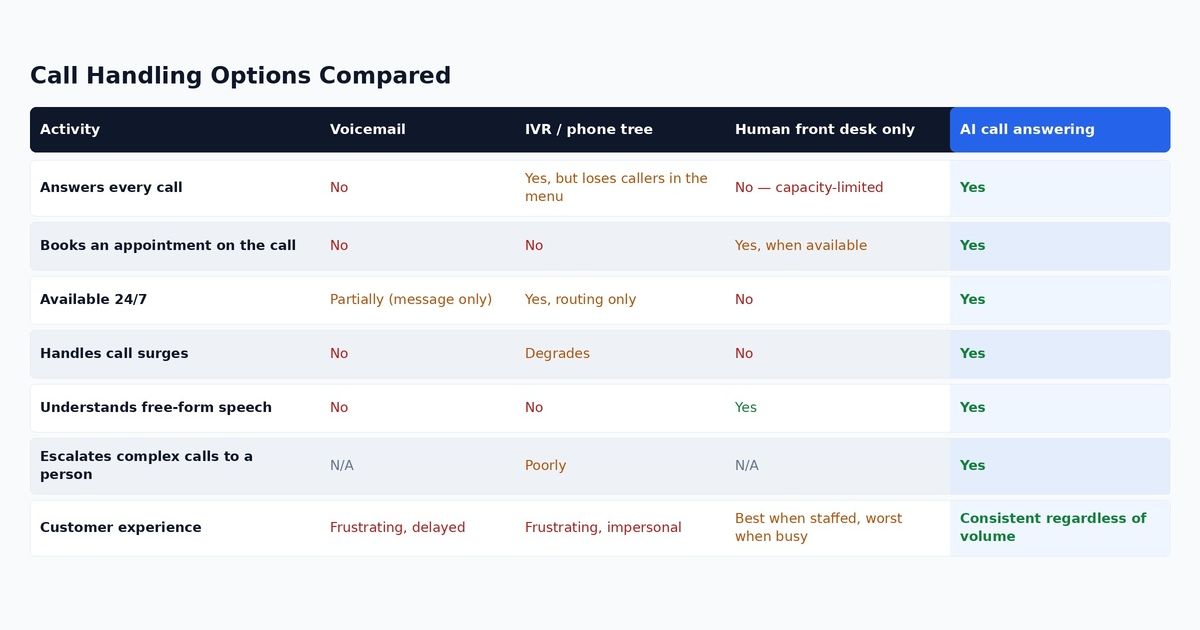
How this compares to what's answering your phones now
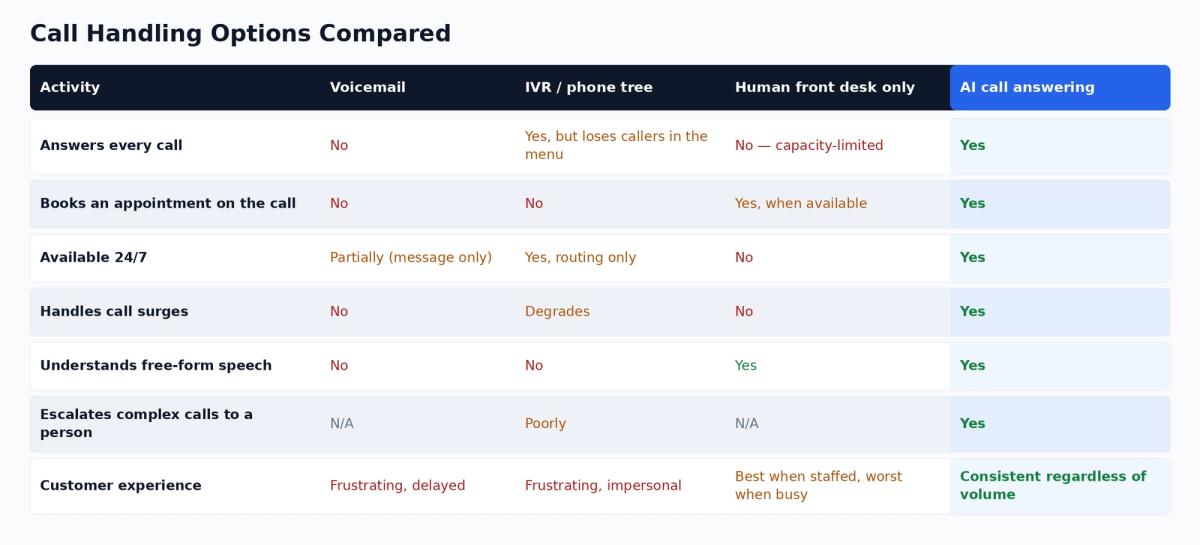
The honest comparison isn't AI versus a great advisor picking up on ring one — a skilled human beats AI on nuance every time. The comparison that matters is AI versus what's actually answering the phone on a Tuesday at 12:40 pm when the desk is three deep, and the lines are lighting up. On that comparison, AI wins by simply existing where nothing currently does.
Where this connects to the rest of your funnel
Call answering, no-show prevention, and lead follow-up are three stages of the same failure pattern, and treating them separately misses the compounding effect of fixing all three.
- A call that goes unanswered never becomes a booking.
- A booking that isn't confirmed and reminded well becomes a no-show.
- A lead that isn't followed up persistently enough never converts at all.
Fixing only the middle stage — reminders — while the first stage still leaks callers to voicemail is solving downstream of the real loss. Missed calls are the widest part of the funnel, and the first place volume disappears. Dealers who fix call answering first tend to see the effect show up as more bookings needing reminders, which then makes the no-show layer worth more, not less.
The same logic extends to sales-side phone coverage. A missed call from a shopper asking about a specific unit is functionally the same failure as car dealer text lead generation going unanswered — different channel, same root cause of nobody being available at the moment of intent.
What to measure
Track these four, ideally pulled monthly from your phone system and scheduler together:
- Missed-call rate. Calls that rang but went unanswered, as a share of total inbound. Most dealerships have never measured this because most reporting only covers answered calls.
- Voicemail-to-callback conversion. Of the voicemails left, how many actually get a return call, and how fast? This number is usually worse than expected.
- Call-to-booking rate. Of calls answered, how many end in a scheduled appointment on that call versus "we'll call you back."
- After-hours call volume and outcome. How many calls come in outside business hours, and what currently happens to them — this is usually the single most improvable number in the whole list.
A realistic path to implementation
Week 1 — Baseline the phones. Pull call logs from your current phone system, even if it's a blunt instrument. You need missed-call rate and after-hours volume before you can prove anything changed.
Week 2 — Connect to the live scheduler. An AI call-answering system that can't see open bays can only take a message — which is barely better than voicemail. Scheduler integration is what makes it a booking tool rather than an answering service.
Week 3 — Set escalation rules. Decide explicitly what routes to a human immediately: diagnostic uncertainty, price pushback, anything emotionally charged. Get this right, and advisors trust the system; get it wrong, and they route around it.
Week 4 and on — Watch the call-to-booking rate climb before the no-show rate moves. This is the correct order of operations. More calls converting to bookings means more appointments entering the reminder pipeline — which is where the no-show prevention layer starts doing its job.
Every phone call to the service lane is a customer who has already decided to bring you their vehicle. The only question is whether anyone picks up before they call the next dealership instead. Reminders, confirmations, and no-show prevention all assume the booking already exists — but the booking only exists if the call was answered in the first place.
Super Producer's AI call answering picks up every line, books directly into your live schedule, and hands anything that needs a human straight to your team with the context already gathered.
Stop losing bookings to a busy signal.
Frequently asked questions
1. Does AI call answering replace my service BDC or front desk staff? No. It answers the calls nobody currently can — overflow, after-hours, lunch gaps — and hands anything requiring judgment to a live person with full context already captured. It removes the capacity ceiling, not the team.
2. Will customers know they're talking to AI on the phone? Some will notice, and most care less than dealers expect. What frustrates callers is silence, hold music, or a menu that doesn't match their question — not the fact that a system booked their oil change efficiently.
3.How is this different from an IVR system?An IVR routes based on menu selections and loses callers who don't fit the options offered. AI call answering listens to what the caller actually says and responds to the request directly, including booking the appointment in the same call.
4. What happens to calls AI can't handle?They escalate to a live advisor or BDC agent immediately, with the vehicle, concern, and contact details already captured — so the human isn't starting the conversation from zero.
5. Should I fix call answering or no-show prevention first? Call answering, if you have to choose. A missed call never becomes an appointment at all, which is a larger loss than an appointment that gets rebooked instead of no-showing. In practice, most dealers running both find they reinforce each other.

Manan Bhalodia
Expert in automotive AI solutions and customer service optimization. Passionate about helping automotive dealerships leverage technology for growth.