On this page
Introduction: The State of the U.S. Used Car Market
The U.S. used-car market has entered a new phase in which digital infrastructure is no longer optional—it is central to survival. Dealerships today operate in an environment shaped by post-pandemic normalization, rising interest rates, and increasingly digital-first car buyers.
One of the biggest shifts is competition intensity. Prices have stabilized after pandemic-era spikes, but demand pressure remains high, forcing dealers to optimize every operational layer. At the same time, interest rate hikes have reduced buyer affordability, meaning fewer people qualify easily for financing. This puts additional pressure on dealerships to convert faster and more efficiently.
Inventory visibility is now a competitive advantage. Dealers who update listings in real time and syndicate across platforms like Cars.com or CarGurus consistently capture leads earlier than competitors relying on manual processes. Spreadsheet-based inventory tracking, once common, now creates serious inefficiencies such as duplicate listings, outdated pricing, and missed online visibility.
The used car dealership industry itself is massive, valued at approximately $173.9 billion in 2024, showing how critical operational efficiency has become at scale.
At the same time, consumer behavior has permanently shifted online. According to Google, 92% of car buyers research vehicles online before visiting a dealership, reinforcing that digital inventory accuracy directly impacts revenue.
Sources:
- https://www.thinkwithgoogle.com/data/car-buying-online-research-statistics/
- https://investors.cargurus.com/news-releases/news-release-details/cargurus-study-uncovers-shift-car-shopper-sentiment-prices-and
- https://static.ibisworld.com/united-states/market-size/used-car-dealers/1004
- https://www.nada.org/nada/research-data/nada-data
Book a free demo and see Super Producer respond to a lead in real time.
What Is Used Car Inventory Software?
Used car inventory software is the operational backbone that allows dealerships to manage, price, list, and distribute their vehicle inventory across digital and physical channels.
It typically falls into two categories:
1. Inventory Management Software (Internal Use)
- VIN decoding
- Lot tracking
- Pricing tools
- DMS synchronization
- Internal reporting
2. Inventory Marketing Software (External Distribution)
- Marketplace syndication (AutoTrader, Cars.com, etc.)
- Listing distribution
- Ad feed generation
- Lead capture integration
Modern dealerships increasingly require both layers integrated into a single ecosystem. Without integration, dealerships risk outdated listings, inconsistent pricing, and missed leads.
Research shows that 93% of shoppers value digital tools that save time, but still prefer final purchases in-store—meaning accuracy in online listings is critical.
Source:https://www.coxautoinc.com/solutions/inventory/
Here's a closer look at why every used car dealer needs inventory management software."
U.S. Dealership Landscape: Franchise vs Independent
Before selecting software, dealers must understand their operating model.
Franchise dealerships (Ford, Toyota, GM, etc.) often depend on OEM-approved systems and must integrate with platforms like CDK Global or Reynolds & Reynolds.
Independent dealerships have more flexibility but typically operate under tighter budgets and require all-in-one solutions.
Buy Here Pay Here (BHPH) dealers require additional compliance and finance tracking capabilities.
Multi-location dealer groups need centralized dashboards and cross-location inventory visibility.
The U.S. dealership ecosystem is highly consolidated. There are roughly 16,990 franchised dealerships, with the top 150 dealer groups controlling nearly 30% of the market.
Sources:
- https://www.mckinsey.com/industries/automotive-and-assembly/our-insights/boosting-auto-sales-productivity-a-playbook-for-excellence
- https://www.nada.org/nada/research-data/nada-data
Key Features to Look For in Inventory Software
Modern inventory platforms must go beyond basic listing management.
Key features include:
- VIN decoding and automation
- Marketplace syndication
- Real-time inventory synchronization
- Market-based pricing intelligence
- Photo and media optimization
- Mobile-first listing tools
Speed matters significantly. Dealers using advanced systems like vAuto report faster inventory turnover by up to 5 days on average.
Additionally, data-driven acquisition tools can significantly improve profitability.
Sources:
DMS Integration: The Most Critical Factor
A Dealer Management System (DMS) is the operational core of any dealership, managing accounting, F&I, service, and inventory.
Key DMS platforms include:
- CDK Global
- Reynolds & Reynolds
- Tekion
- DealerSocket
If inventory software does not integrate properly with a DMS, implementation failure is highly likely.
Integration must be:
- Real-time (not batch updates)
- Certified (not third-party workaround)
- Bi-directional (updates flow both ways)
Full Integration Ecosystem
Modern inventory systems must integrate beyond the DMS:
- CRM systems (lead tracking)
- Marketplace platforms (Cars.com, CarGurus, etc.)
- Website integrations (Dealer.com, DealerInspire)
- Google Vehicle Ads feeds
- Meta (Facebook/Instagram) catalog ads
- Recon and service systems
More than 56% of leads arrive after hours, and response delays significantly reduce conversions.
This is where BDC tools pick up the slack — see our guide to automotive BDC tools for car dealerships .
Source:
Great inventory software gets your listings in front of buyers. What happens after they click? See how Super Producer makes sure no lead goes cold.
U.S. Compliance & Legal Requirements
Inventory software must support regulatory compliance.
Key rules include:
- FTC Used Car Rule (Buyers Guide requirement)
- CARS Rule (pricing transparency regulations)
- State disclosure laws (California, Texas, New York)
- CCPA data privacy requirements
Non-compliance can result in fines of up to $53,088 per violation.
Sources:
- https://www.ftc.gov/business-guidance/resources/dealers-guide-used-car-rule
- https://www.elitefipartners.com/post/staying-compliant-with-the-ftc-s-used-car-rule-what-dealers-need-to-know
How Inventory Software Impacts Sales Performance
Inventory systems directly influence revenue performance.
Key improvements include:
- Faster lead response times
- Higher listing conversion rates
- Reduced stale inventory losses
- Increased showroom traffic
Shoppers today visit fewer dealerships than ever—just 1.4 visits per purchase on average.
Source:
- https://www.thinkwithgoogle.com/intl/en-emea/consumer-insights/consumer-trends/automotive-digital-transformation/
- https://www.demandlocal.com/blog/consumer-behavior-car-buying-statistics/
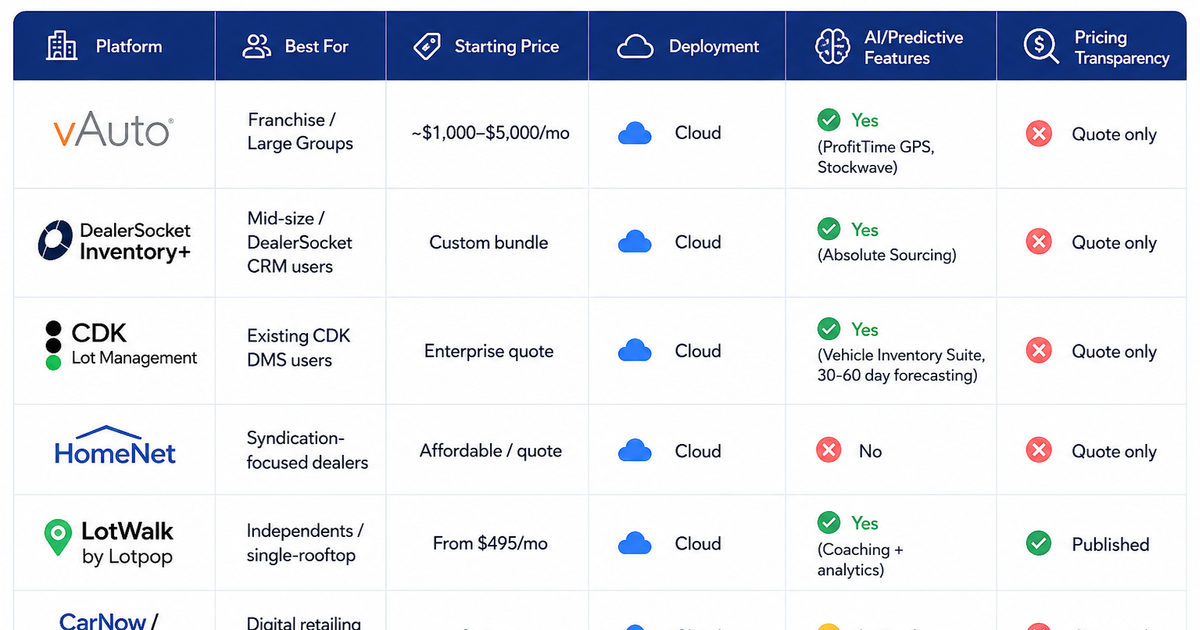
Top U.S. Used Car Inventory Software Platforms - Comparison Overview
For a broader look across inventory, CRM, and AI tools, check out our best software for used car dealers in 2026
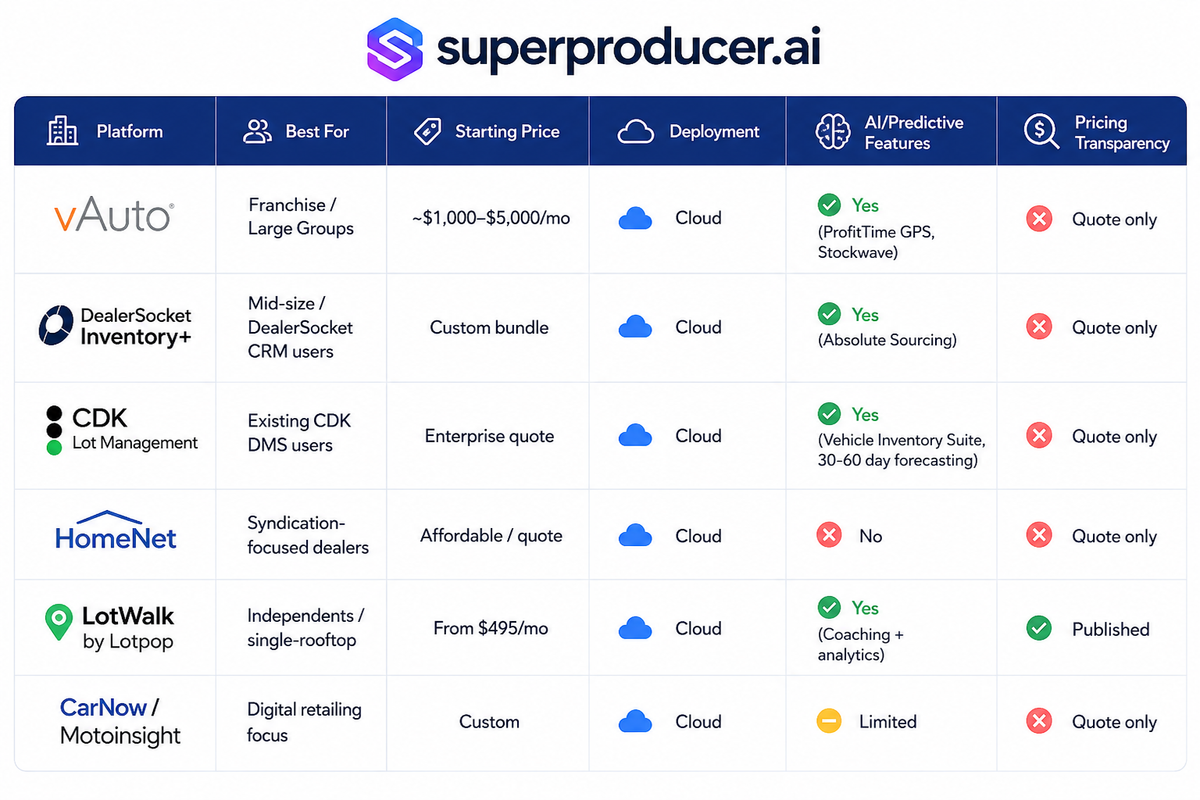
Sources: Podium — automotive inventory management platforms: https://www.podium.com/article/automotive-inventory-management
Readycontacts — top auto dealership software companies: https://www.readycontacts.com/blog/auto-dealership-software-companies/ LotWalk pricing: https://www.lotpop.com/pricing vAuto pricing context: https://www.spyne.ai/blogs/vauto
DealerRefresh HomeNet community review: https://forum.dealerrefresh.com/threads/community-review-homenet.11713/
CDK predictive AI: https://www.cdkglobal.com/insights/why-predictive-ai-crucial-used-car-inventory-2025
Common Mistakes When Choosing Inventory Software
Avoiding common mistakes can prevent costly implementation failures.
Choosing Based on Price Alone
Risks include:
- Hidden costs
- Limited functionality
- Poor integrations
Ignoring Google Vehicle Ads Compatibility
Can result in:
- Reduced visibility
- Missed sales opportunities
Using National Pricing Data Only
Can cause:
- Incorrect pricing
- Longer inventory aging
Selecting Enterprise Software for Small Operations
May lead to:
- Unnecessary complexity
- Higher costs
Overlooking Scalability
Can create future migration challenges.
Assuming CRM Is Included
Always verify included functionality.
Underestimating Training Requirements
Poor onboarding often leads to low adoption.
Many of these mistakes stem from sticking with manual processes for too long — see our full manual vs. automated inventory management comparison.
Source:
Proactive Training Solutions — internet lead response best practices: https://proactivetrainingsolutions.com/internet-lead-response-time-automotive-dealership/
ROI of the Right Inventory Management System
The right software delivers measurable business value.
Faster Inventory Turnover
Results include:
- Reduced days-on-lot
- Faster cash flow
Lower Holding Costs
Benefits include:
- Reduced floorplan expenses
- Lower depreciation losses
Better Lead Conversion
Accurate listings improve sales opportunities.
Improved Pricing Accuracy
Benefits include:
- Better gross profit
- More competitive positioning
Operational Efficiency
Automation reduces administrative workload.
Sources:
- vAuto Provision (5 days faster): https://www.vauto.com/products/provision/
- BCG 15–20% holding cost reduction via AI: https://www.charterglobal.com/how-ai-is-transforming-car-dealerships-2025/
- vAuto Stockwave 40% gross profit increase: https://www.vauto.com/
- CDK — data integration eliminates manual reporting errors: https://www.cdkglobal.com/insights/4-ways-data-reshaping-dealership-inventory-strategy
- Demand Local — 78% first-responder capture rate: https://www.demandlocal.com/blog/lead-to-sale-conversion-statistics/
A 7-Step Framework for Evaluating Inventory Software
A structured evaluation process improves decision-making.
Step 1: Define Your Dealership Type
Understand your operational requirements.
Step 2: Audit Your Technology Stack
Review existing systems and integrations.
Step 3: Create a Non-Negotiables Checklist
Identify must-have features before vendor discussions.
Step 4: Request Real Inventory Demonstrations
Use your actual inventory data during demos.
Step 5: Evaluate Onboarding and Support
Assess implementation resources and service quality.
Step 6: Review Contract Terms Carefully
Examine pricing, renewal terms, and exit clauses.
Step 7: Speak With Existing Customers
Request references from dealerships similar to yours.
The Future of Used Car Inventory Management
Predictive Inventory Acquisition
AI forecasts which models will sell fastest using historical sales data, market trends, and buyer behavior patterns. Dealers using vAuto's Conquest have reported up to a 39% increase in new car sales through data-driven stocking decisions.
Automated Vehicle Description Generation
AI generates VDP listing copy at scale — faster merchandising, consistent quality, and SEO-optimized descriptions across every unit. What once took a staff member 10 minutes per vehicle now takes seconds.
AI-Powered Inventory Merchandising
Intelligent VDP promotion, automated image overlays, and attention-capturing content scaled across entire inventory — without requiring design resources for each listing.
Source: https://www.charterglobal.com/how-ai-is-transforming-car-dealerships-2025/
Digital Retailing Integration
The line between inventory management and the consumer buying experience is dissolving. Platforms now connect inventory data directly to online deal-building tools, allowing buyers to configure financing, trade-in value, and final price — all before stepping into the showroom.
Source: https://www.coxautoinc.com/solutions/inventory/
Conclusion: Making the Right Call for Your Dealership
Choosing the right used car inventory software is not about selecting the most feature-rich platform. It is about finding a solution that aligns with your dealership's operational model, integrates with your existing technology stack, supports compliance requirements, and demonstrably improves inventory performance.
For most franchise dealers or large groups: vAuto remains the standard, particularly for its pricing intelligence and Cox ecosystem depth.
For mid-sized groups with DealerSocket CRM: DealerSocket Inventory+ offers the tightest workflow integration.
For independents under 100 units/month: Lotpop delivers meaningful AI-driven guidance at a price point that makes sense.
For dealers prioritizing syndication: HomeNet is best-in-class for feed management and marketplace reach.
The best platforms deliver measurable benefits through better pricing, faster inventory turnover, improved lead conversion, and increased operational efficiency. By evaluating software using the 7-step framework above and pressure-testing vendors on DMS integration, compliance support, and real-world references, dealerships can make technology investments that support sustainable growth — not just incremental improvement.
Don't let a great inventory setup go to waste on slow follow-up. Book a free demo and see Super Producer respond to a lead in real time.

Manan Bhalodia
Expert in automotive AI solutions and customer service optimization. Passionate about helping automotive dealerships leverage technology for growth.