On this page
How to Reduce No-Show Appointments: Confirmed Customers Showed Up 53% of the Time. Unconfirmed: 30%
Booked appointments don’t always turn up, and most dealerships can’t say why. We studied one store’s records to find out what separated the customers who showed from the ones who didn’t. Customers who confirmed their appointment showed up far more often: 53.2% against 30.3%. Our first look at the data pointed the other way, and we nearly missed it. This post covers the result, how to read it, and the routine behind it.
How we measured: Data from one independent used-car dealership in New Jersey that SuperProducer runs the BDC for, Jan–Jul 2026, 1,385 booked customers.
Do confirmation calls improve dealership show rates?
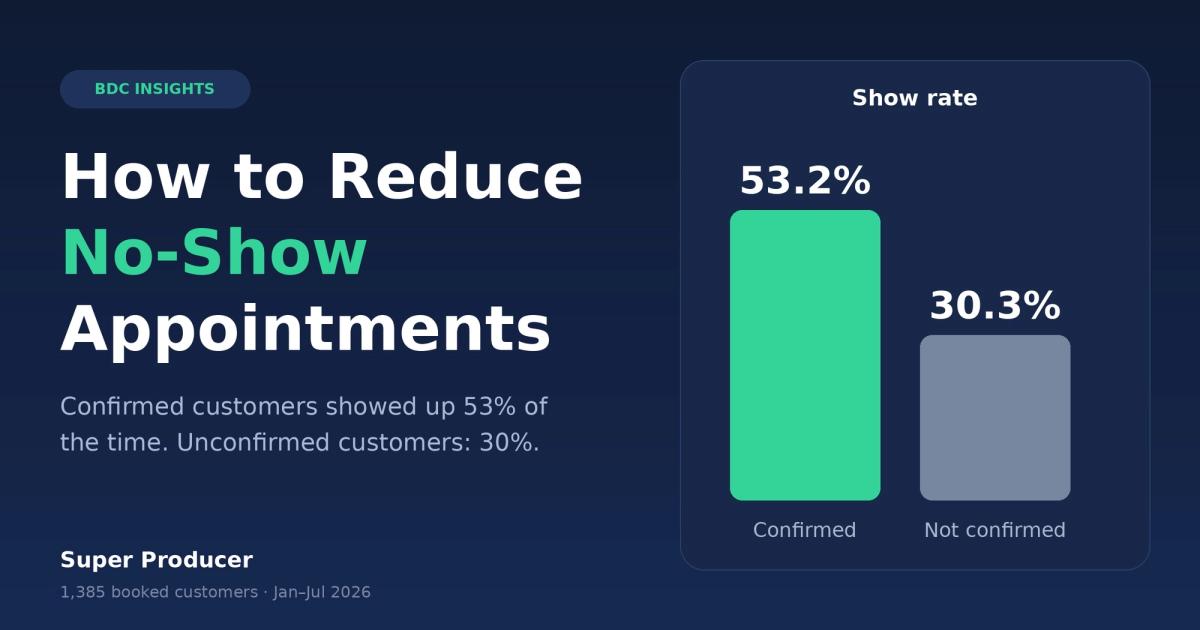
Yes, in this store’s data. Booked customers who confirmed showed up 53.2% of the time. Customers who didn’t confirm showed up 30.3% of the time. That compares 361 confirmed customers with 1,024 unconfirmed ones, from January to July 2026.
53.2% of confirmed customers showed up.
30.3% of unconfirmed customers did.
This shows what happened together, not proof of cause. Customers who confirmed showed up far more often, but we can’t say the call itself made the difference. A customer who answers the phone and confirms may already be the one more likely to come.
For a BDC manager, the practical reading is simple: the unconfirmed appointment is the one to worry about. In this store, roughly seven in ten of them did not show.
How did we measure confirmation, and why do the numbers differ?
You will see two kinds of figures in this post, and they measure different things. First, the definitions we use:
- Confirmed: the store’s records show the customer acknowledged the appointment before the visit.
- Showed: the customer arrived for the booked visit.
- Show rate: the customers who showed, divided by the customers who booked.
The first kind follows each booked customer from January to July. The second kind comes from what the BDC recorded each month, and it counts any appointment nobody marked as a no-show, so those figures run lower. The table keeps the two apart.
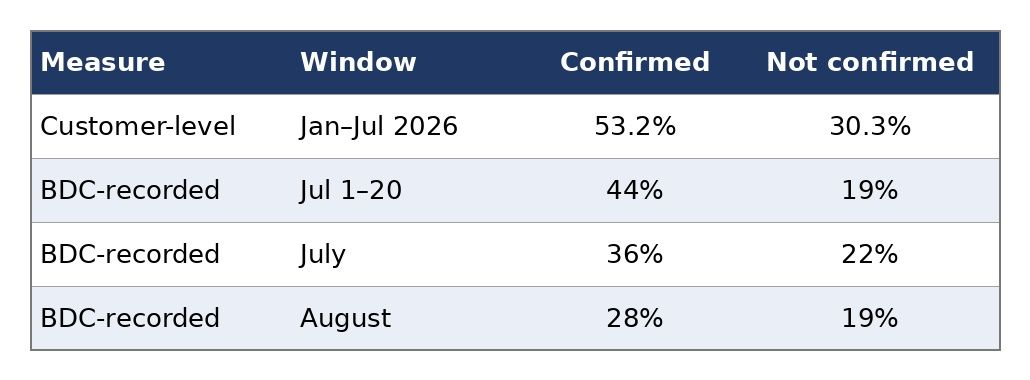
Don’t read one row against another as if they were the same measure. What the rows share is the direction: in every window, confirmed appointments showed up more often than unconfirmed ones.
Does it hold for local, New York City, and distant customers?
Yes. In all three groups, confirmed customers showed up more often (all figures January–July 2026).
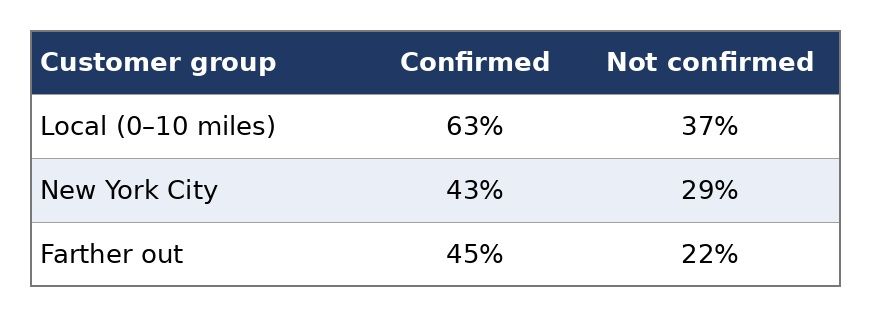
The result also survived a second check. With customers who had submitted a credit application removed, the gap held: 53.4% against 28.4%.
Confirmed customers also went on to buy more often: 12.7% against 7.5%. The same caution applies. This is an association, and we are not claiming the confirmation call produced the sale.
How did we almost get this wrong?
Our first pass compared group averages across 17 area codes and found almost no link between confirmation and showing up. The correlation was 0.10. On that view, confirmation looked as if it barely mattered.
Then we looked customer by customer. The gap was large and consistent: the 53.2% against 30.3% above.
The lesson applies to any manager reading a dashboard. Averages of groups can hide what happens to individual customers. If your reports roll up by area, by rep or by week, check at least one of them customer by customer before you decide what works.
What does a good confirmation routine look like?
The store we studied built its routine around a few habits:
- Day-before confirmations come first. They are the first task of the morning.
- One rep runs a confirmation desk. That rep works today’s and tomorrow’s appointments, first thing in the morning and again mid-afternoon. A second rep is the backstop.
- Saturday covers Monday. On Saturday, the desk confirms Saturday and Monday appointments, because the store is closed on Sundays.
- The call is a real conversation, not a checkbox.
The confirmed share of appointments climbed as the routine took hold: 25% (Jul 1–20), 42% (July) and 58% (August). The starting point was rough. On one July Saturday, 11 of the 12 appointments on the books were unconfirmed when the store opened.
One honest note: the gap narrowed as coverage grew. In the BDC-recorded figures, confirmed appointments led by 14 points in July and 9 points in August. That is expected. As more appointments get confirmed, confirmation also reaches the weaker appointments, so the confirmed group looks less different from the rest.
What can confirmation not fix?
Only 46 of 289 buyers (15.9%) had ever confirmed an appointment, and 57% of buyers never booked at all (January–July 2026).
Confirmation helps people who have already booked. It does nothing for the many buyers who never book, so a good routine is only half the job. How distance shapes who books at all is a separate story, and so is the walk-in who isn’t really a walk-in. We cover both in separate posts.
How can you test confirmation at your own store?
Don’t take our word for it; run the check on your own bookings. For two weeks, confirm only the odd-numbered bookings and compare the show rates of the two groups. Track show rate on appointments that were actually marked, not on ones nobody marked, so missing records don’t drag the numbers down.
This is our recommendation, not a result we are reporting.
Frequently asked questions
Do confirmation calls increase dealership show rates?
In one New Jersey used-car store’s data, customers who confirmed showed up 53.2% of the time, against 30.3% for those who didn’t. That is an association, not proof that the call caused it.
When should a dealership confirm an appointment?
The day before, as the first task of the morning, with a same-day check. The store we studied also confirmed mid-afternoon again, and on Saturdays it confirmed Saturday and Monday appointments because it is closed Sundays.
What percentage of appointments should a BDC confirm?
All of them. The store we studied went from 25% of appointments confirmed to 58% in about six weeks.
What should you say on an appointment confirmation call?
Make it a real conversation, not a checkbox. The data behind this article contains no script, so we don’t offer one here.
How do you reduce no-shows at a car dealership?
Confirm every booked appointment the day before, give one rep the confirmation desk with a backstop, and measure show rate only on appointments that were actually marked. Confirmed customers showed up more often in our data; that does not prove confirmation is the cause.
Conclusion
AI won’t save your dealership. A dedicated human BDC will.
In this store, the customers who confirmed showed up far more often, and the confirmations came from a person making a real call. If you want help building a confirmation desk of your own, Book a BDC Consultation.

Manan Bhalodia
Expert in automotive AI solutions and customer service optimization. Passionate about helping automotive dealerships leverage technology for growth.